

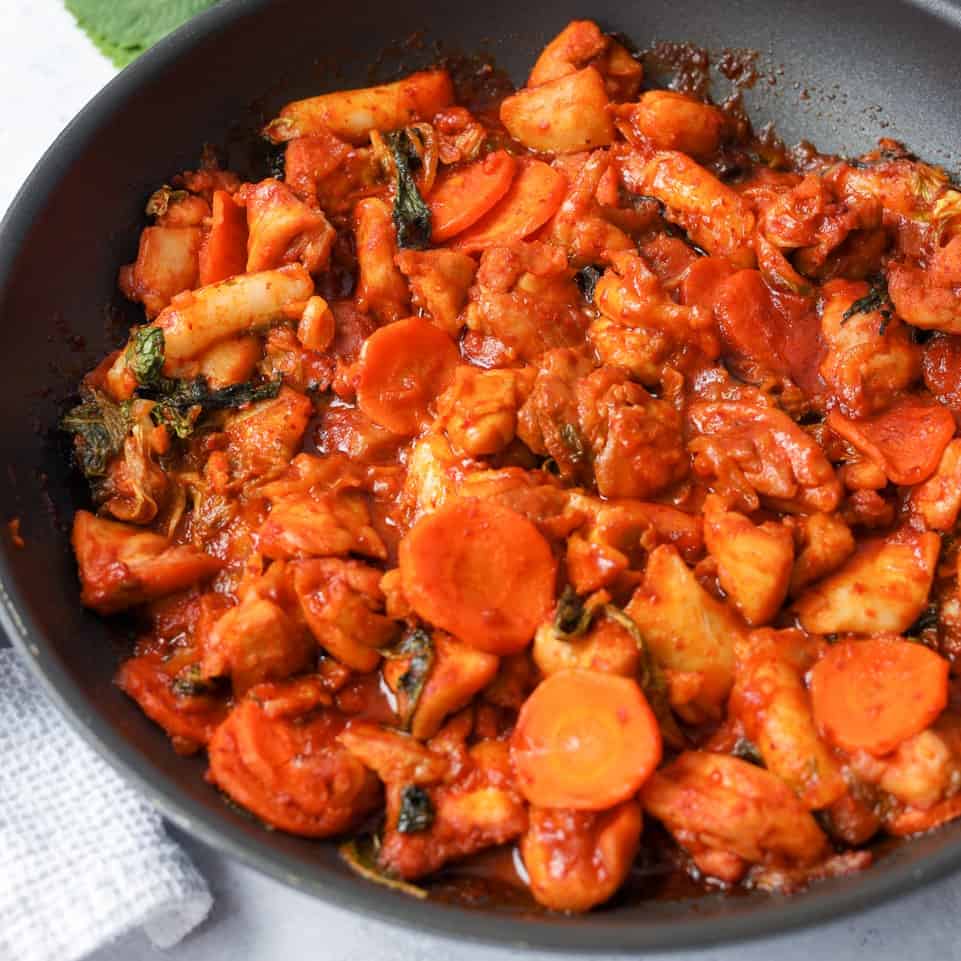
Tender, juicy chicken stir-fried with cabbage, carrots, chewy rice cakes, and perilla leaves in a sweet, savory, and spicy sauce. This easy dak galbi recipe is ready in just 30 minutes using one pan. I marinate the chicken in a gochujang-based sauce to give it a rich, spicy flavor before stir-frying.
Jump to:
Dak galbi is a popular Korean spicy chicken stir-fry made with marinated chicken, vegetables, and chewy rice cakes. "Dak" means chicken and "galbi" means ribs in Korean. Despite its name, the dish doesn't contain ribs because it was developed as an affordable alternative to grilled pork ribs.
It's traditionally cooked in a large pan at the table and shared with family or friends, often with steamed rice or fresh lettuce wraps. This dish is especially popular in Chuncheon, South Korea, where an entire street is lined with restaurants specializing in dak galbi.
One of my favorite things about this dish is how the leftover sauce can be used to make fried rice or stir-fried noodles after the chicken and vegetables are eaten.

When I make dak galbi for dinner, I cook the vegetables first so they have time to soften before adding the chicken. I then stir-fry the chicken with its marinade, allowing the sauce to coat the vegetables and rice cakes as everything cooks together.
Ingredients & Substitutes
Exact ingredient amounts are listed in the recipe card at the bottom of this page.

- Chicken Thighs: Use boneless, skinless chicken thighs because their higher fat content helps keep the chicken juicy during stir-frying. Chicken breast also works, but cook it for less time to prevent drying out.
Marinade
- Garlic & Onion: Add a savory, aromatic base to the sauce, with the onion providing natural sweetness to balance the spicy gochujang.
- Gochujang Paste: A thick Korean fermented red chili paste that gives the sauce its signature sweet, savory, and spicy flavor. Look for it at Korean grocery stores in varying spice levels.
- Gochugaru: Korean red pepper flakes that add heat and a vibrant red color to the sauce. It's best to use coarse flakes, but fine flakes also work. Find it at Korean grocery stores or online.
- Regular Soy Sauce: Adds saltiness and savory flavor to balance the spicy sauce. Light soy sauce or low-sodium soy sauce also works.
- White Granulated Sugar: Balances the heat and saltiness of the sauce. Honey or cane sugar also works.
- Ginger: Adds a warm, aromatic flavor that complements the spicy gochujang sauce.

Stir-Fry Ingredients
- Napa Cabbage: Softens during stir-frying and absorbs the spicy sauce. Regular green cabbage also works.
- Carrot: Adds natural sweetness and a slightly crisp texture.
- Onion: Adds sweetness as it softens during cooking. Yellow or white onions both work.
- Perilla Leaves: Korean herb leaves with a distinctive minty, herbal flavor. Find them at Korean grocery stores or omit them if unavailable.
- Korean Rice Cakes: Also called tteok, these chewy cylindrical rice cakes absorb the spicy sauce. I recommend fresh or refrigerated rice cakes for their chewy texture. Soak firm, refrigerated rice cakes in warm water for about 10 minutes. Frozen rice cakes also work, but soak them for about 20-30 minutes. Find them at Korean or Asian grocery stores.
- Vegetable Oil: Or use a neutral cooking oil with a high smoke point, such as canola or refined avocado oil.
Note: Asian ingredients are typically available at most Asian grocery stores or online.
Expert Tips
- Prepare ingredients in advance: Have the vegetables chopped and rice cakes softened before stir-frying to prevent overcooking while preparing other ingredients.
- Use a large pan: Gives the vegetables room to cook evenly instead of steaming in excess moisture.
- Keep the heat at medium: Prevents the sugary gochujang marinade from burning before the chicken cooks through.
- Let the sauce reduce: Cook uncovered so excess moisture evaporates and the sauce thickens enough to coat the ingredients.
Instructions
Below are step-by-step instructions on how to make dak galbi:

- Soak the rice cakes: Soak firm, refrigerated rice cakes in warm water for about 10 minutes to soften them. For frozen rice cakes, soak in warm water for about 20-30 minutes until thawed and separated. Drain and set aside. If using fresh, soft rice cakes, skip this step.

- Marinate the chicken: Dice the chicken thighs into 1.5-inch pieces and transfer to a large bowl. Add all the marinade ingredients directly to the chicken and mix thoroughly until evenly coated. Marinate for about 10-15 minutes.

- Cook the onions: Heat vegetable oil in a large pan over medium heat. Add the sliced onions and stir-fry for about 1-2 minutes until softened.

- Cook the vegetables: Add the carrots, napa cabbage, rice cakes, and perilla leaves. Stir-fry for about 3-4 minutes until the cabbage begins to soften.

- Cook the chicken: Add the chicken to the pan, scraping out any remaining marinade from the bowl. Mix with the vegetables and rice cakes. Spread the chicken evenly across the pan and cook uncovered for about 10 minutes, stirring occasionally, until the chicken reaches an internal temperature of 165°F (74°C) and the sauce has thickened enough to coat the ingredients.

- Serve: Remove from the heat and serve hot with steamed rice or fresh lettuce wraps.
Storage & Reheating
- Refrigerator: Store leftover dak galbi in an airtight container in the refrigerator for up to 4 days.
- Freezer: I don't recommend freezing dak galbi because the vegetables and rice cakes will change in texture after thawing.
- Reheating: Microwave in 1-minute intervals, stirring between intervals, until heated through. Or reheat in a pan over medium heat, stirring occasionally until hot. Add a splash of water if the sauce becomes too thick.
Pairing Suggestions
Serve dak galbi with:
- Steamed White Rice: Balances the spicy sauce and makes a filling meal.
- Korean Cucumber Salad: Adds a refreshing crunch to complement the spicy chicken.
- Kimchi: Adds a tangy flavor that pairs well with the savory sauce.
FAQ
Reduce the gochugaru and use a mild gochujang paste. Avoid omitting the gochujang entirely because it provides the sauce's signature sweet and savory flavor.
The vegetables release moisture as they cook. Continue cooking uncovered over medium heat, stirring occasionally, until the excess moisture evaporates and the sauce thickens enough to coat the ingredients.
Use gluten-free gochujang and substitute regular soy sauce with tamari. Check that the gochugaru and rice cakes are certified gluten-free or labeled gluten-free, as ingredients can vary by brand.
More Like This
Check out my other Korean recipes:
📖 Recipe

Easy Dak Galbi (Korean Spicy Chicken Stir-Fry)

Ingredients
- 1 lb skinless boneless chicken thighs
- 2 cups napa cabbage chopped
- ½ cup carrot cut into ¼-inch-thick rounds
- ¾ cup Korean rice cakes
- ½ cup onion thinly sliced
- 6 perilla leaves stems removed, roughly chopped
- 1 tablespoon vegetable oil or any neutral oil
Marinade
- ½ cup onion finely diced
- 3 garlic cloves minced
- ¼ cup gochujang mild kind
- 4 teaspoon gochugaru
- 4 teaspoon regular soy sauce
- 4 teaspoon white granulated sugar
- ¾ teaspoon ginger peeled and grated
Instructions
- Soak firm, refrigerated rice cakes in warm water for about 10 minutes to soften them. For frozen rice cakes, soak in warm water for about 20-30 minutes until thawed and separated. Drain and set aside. If using fresh, soft rice cakes, skip this step.
- Dice the chicken thighs into 1.5-inch pieces and transfer to a large bowl. Add all the marinade ingredients directly to the chicken and mix thoroughly until evenly coated. Marinate for about 10-15 minutes.
- Heat vegetable oil in a large pan over medium heat. Add the sliced onions and stir-fry for about 1-2 minutes until softened.
- Add the carrots, napa cabbage, rice cakes, and perilla leaves. Stir-fry for about 3-4 minutes until the cabbage begins to soften.
- Add the chicken to the pan, scraping out any remaining marinade from the bowl. Mix with the vegetables and rice cakes. Spread the chicken evenly across the pan and cook uncovered for about 10 minutes, stirring occasionally, until the chicken reaches an internal temperature of 165°F (74°C) and the sauce has thickened enough to coat the ingredients.
- Remove from the heat and serve hot with steamed rice or fresh lettuce wraps.
Adrian
I'd add one thing to Nicola's question about the perilla leaves.
The leaf is doing a job in dakgalbi: it's the fresh green bite at the end that cuts through the sweet-hot sauce. Leaving it out is fine, but the dish comes out flatter for it.
What does that job from a shop that has never heard of perilla: the green tops of a leek, sliced very thin on the bias, or flat-leaf parsley. Use more than feels right, a good handful, and stir it in off the heat, once the pan has left the flame. That green note is the whole point and it dies within about a minute of cooking.
Two things I'd skip: curly parsley, which is mostly colour, and basil, which reads of anise rather than of that green-grass note. For ssam I don't think anything honest exists, but for dakgalbi the swap works.
I've spent a while fitting Korean recipes onto a northern European shelf, so I'm curious: do leek greens turn bitter for you at that heat? I keep my slices to the pale-to-mid green part, which is where I think the difference is.
Christie Lai
Thanks for sharing your suggestions! I haven't tried substituting perilla leaves with leek greens in my dak galbi, so I can't say for certain whether they'd become bitter. I imagine adding the thinly sliced, tender green portions off the heat would help prevent overcooking. That said, perilla leaves have a distinct minty, herbal flavor that's difficult to replicate. Flat-leaf parsley could add some freshness, but the flavor would be different. I appreciate you sharing your experience adapting Korean recipes with locally available ingredients!
Adrian
Fair enough on the minty edge. That is the part I cannot fake, and I would rather say so than sell the swap as a match. Leek greens give the green finish, not the herb. If the pale-to-mid slices hold up bitter-free for you, I want to hear it, since that is the piece I cannot test from my own shelf.
Nicola Gregory
Hi I am from the UK and lived in Cheongju for a year teaching English many years ago! Dakgalbi was my absolute favourite meal whilst I was there. I would like to try your recipe and wanted to know what I could use instead of Perilla leaves as I can’t get them.
Many thanks
Christie Lai
Hi Nicola, feel free to omit the perilla leaves in your case as I understand it can be difficult to source.
Dany
Did you use frozen or fresh rice cakes? I ask because I have frozen and they have soaked for 30 minutes and are still quite hard.
christieathome
I used fresh rice cakes. They should become chewy when you go to add them into the hot pan. Just be careful not to overcook frozen rice cakes as they tend to break apart in high heat or prolonged cooking periods.
Heidi | The Frugal Girls
This is such a tasty fun way to upgrade chicken. Spicy and packed with flavor! 💕💕
christieathome
Thanks Heidi! Yes it's one of my favourite ways to cook chicken as it truly hits the spot.